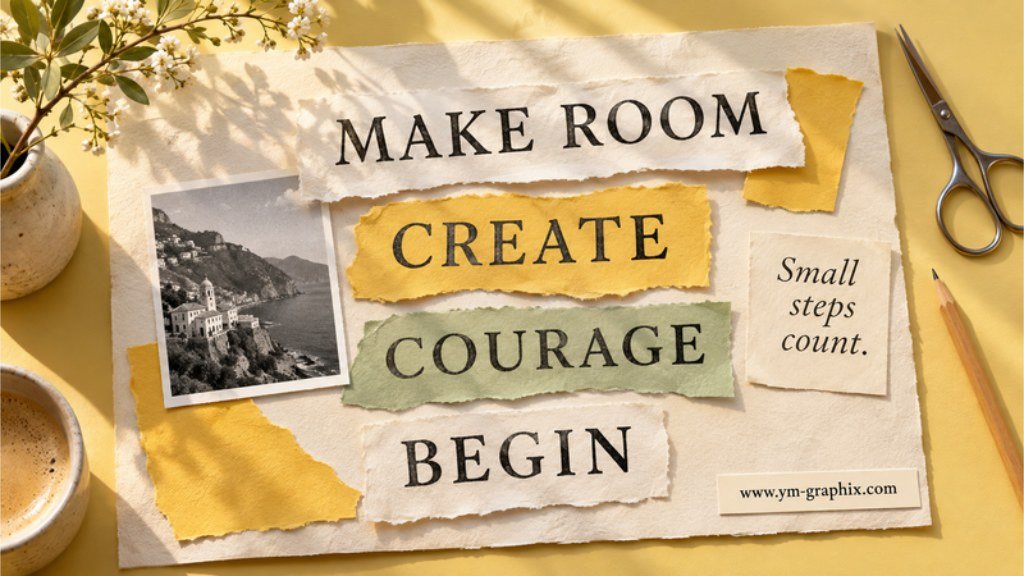
A few good words can give your pictures a voice.
Vision board words are short reminders of the qualities, goals and everyday choices you want to make room for. Start with one anchor word, add a few specific phrases or affirmations, and place them beside images that explain what they mean to you.
Try courage beside a photograph of your first creative project, connection beside a shared table, or make room above a corner you want to turn into a studio. The best word is one you can explain in your own life.
This little word studio brings together 80 single-word ideas, 20 affirmations and 12 short original lines, plus three example layouts. Use them as starting points, rewrite them in your own voice, and keep only the ones that belong on your board.
Disclosure: This article contains affiliate links. If you purchase through them, we may earn a commission at no extra cost to you. The linked resources are optional digital downloads; check each listing for current access options, formats and software requirements.
How to choose vision board words that feel like you
Before browsing fonts or printing anything, finish this sentence: “I want more room for…” Your answer might be curiosity, friendship, steady work or slow mornings. Begin with the quality you want, then choose images and words that make that quality visible.
A single word, a quote and an affirmation do different jobs. A word names a theme: “Explore.” A short line gives it context: “Leave room for a different route.” An affirmation speaks in your voice: “I can try something unfamiliar.” You can use one of each without turning your board into a page of text.
- Choose one anchor. Find the word you would keep if everything else had to go. Give it the largest type.
- Choose three supporting words. Each should add something different. “Create,” “practice” and “share” describe a sequence; “success,” “winning” and “achievement” may repeat the same idea.
- Add a sentence you believe. Use language that feels encouraging enough to return to on an ordinary day.
- Connect it to a choice. Ask what one small decision would look like if you took that word seriously this week.
For a wider starting point, our guide to what to put on a vision board covers images, personal mementos and goal categories. Here, we are focusing on the wording and the way it sits within your collage.
80 vision board words, grouped by the feeling you want
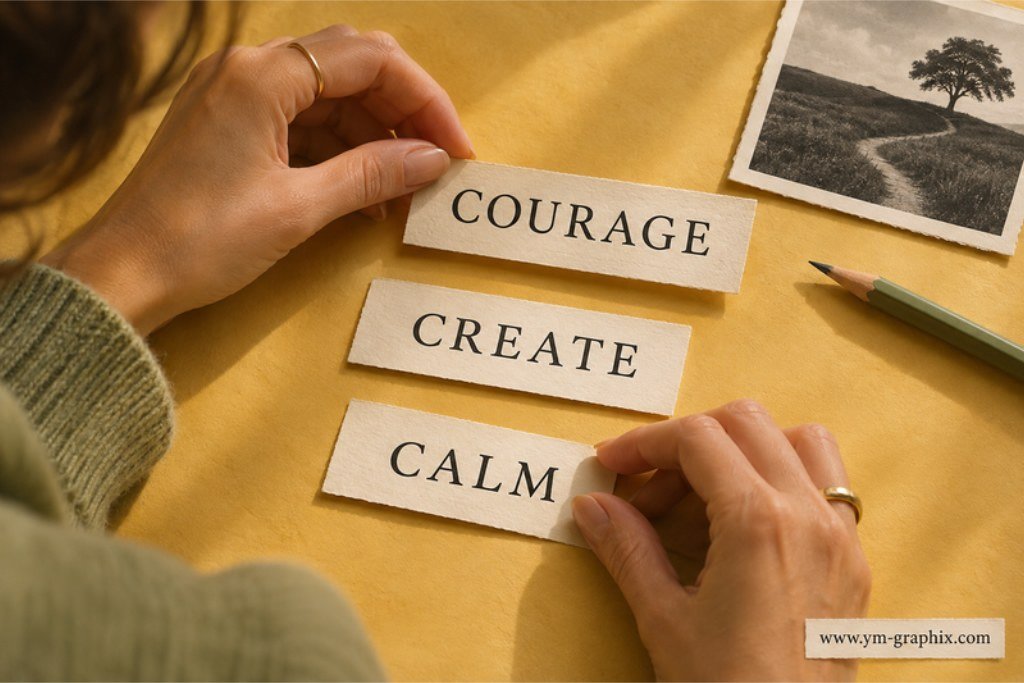
Read these groups slowly and circle anything that catches your attention. Then narrow your selection. A board with five meaningful words can say more than a crowded collection of twenty words you chose because they sounded impressive.
Confidence & courage
Courage · Brave · Trust · Voice · Worthy · Capable · Bold · Confidence · Authentic · Resilient
Choose “voice” if you want to speak up in a meeting, share your work or ask a question you usually keep to yourself. Pair it with an image of the setting where you want to use that voice.
Calm & everyday care
Calm · Rest · Breathe · Gentle · Balance · Ease · Peace · Restore · Nourish · Space
For a slower rhythm, try “space” rather than adding another demand to your board. Leave an open patch around the word and pair it with a photograph of an unhurried moment.
Creativity & learning
Create · Imagine · Explore · Curiosity · Learn · Experiment · Play · Sketch · Discover · Practice
“Practice” works well beside a rough sketch or an unfinished notebook page. It makes room for the part of creating that happens before a polished result exists.
Work & purposeful progress
Focus · Purpose · Craft · Progress · Consistency · Build · Clarity · Initiative · Finish · Contribute
If a work goal feels vague, choose a verb. “Finish” can point to one portfolio piece; “contribute” might mean offering one useful idea. For more work-specific imagery, explore our career guide.
Connection & belonging
Connection · Belonging · Together · Kindness · Friendship · Listen · Support · Presence · Share · Welcome
Use words about the way you want to participate in relationships. “Listen” beside a shared meal is a different invitation from a picture that assumes how someone else should behave.
Adventure & discovery
Adventure · Wander · Journey · Roam · Wonder · Outside · Travel · Openness · Experience · Horizon
A word such as “outside” can connect a big travel dream with a nearby trail. Keep the feeling you want to explore, even when the first version happens close to home.
Home & stability
Home · Roots · Comfort · Security · Order · Enough · Simplicity · Warmth · Grounded · Steady
“Enough” can be a particularly personal anchor: enough room, enough rest, enough time together. Add a note explaining your meaning so the word stays connected to your own priorities.
Growth & a new chapter
Begin · Become · Grow · Renew · Evolve · Possibility · Patience · Intention · Open · Bloom
Choose “begin” for a project you keep postponing, or “patience” for one that takes time. These words can share a board: starting and allowing yourself to learn belong together.
You can also mix groups. Steady + create + connection tells a different story from adventure + courage + begin. Try saying your selection aloud as a description of the season you want to create.
20 positive affirmations for a vision board
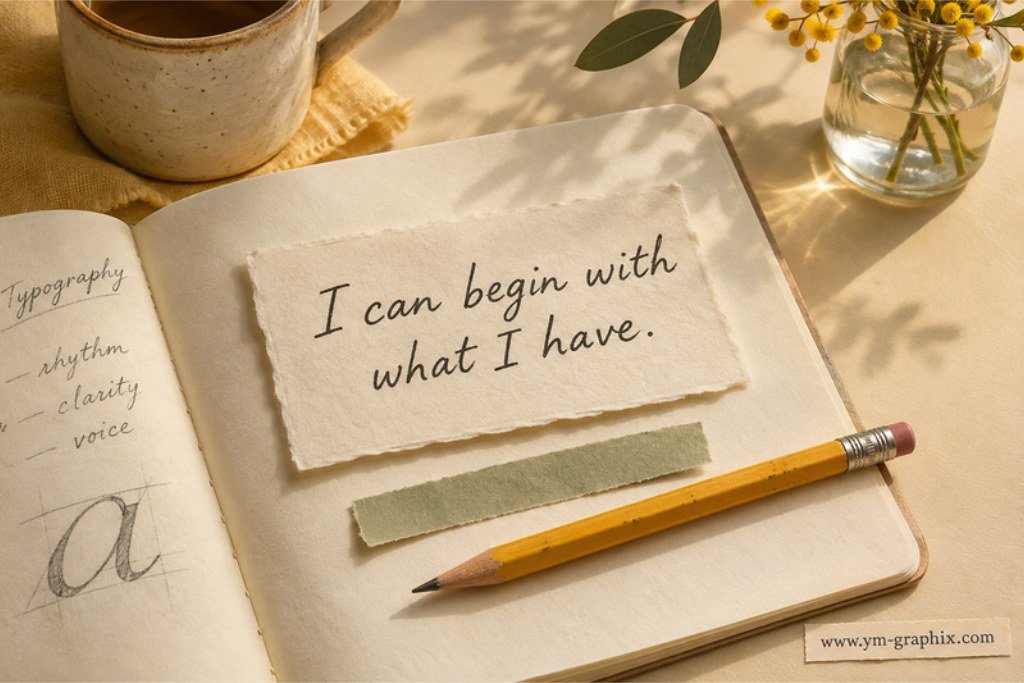
An affirmation can be a short sentence about a choice, value or possibility you want to remember. It does not need to pretend that a difficult situation is already solved. If “I am completely confident” feels distant, “I can take one step while I learn” may be easier to make your own.
The following examples are written for this guide. Change the tense, pronouns or wording until they sound like something you would actually say.
For beginning
- I can begin with what I have.
- I am allowed to be a beginner.
- I can take the next small step.
- I can learn as I go.
- My first version can be imperfect.
For making room
- I can make room for what matters.
- My time deserves thoughtful choices.
- I am allowed to pause and reconsider.
- Rest has a place in my plans.
- I can choose a pace I can sustain.
For confidence & connection
- My voice belongs in the conversation.
- I can ask for help when I need it.
- I can share something before it feels perfect.
- I can bring kindness to the way I speak to myself.
- I can choose relationships where care goes both ways.
For steady progress
- Small actions are worth noticing.
- I can return to a goal after a break.
- My plans can change as I learn more.
- I can celebrate a step without finishing the whole journey.
- I am building a life that reflects my values.
If you would like a ready-designed card beside your own handwritten line, Positive Affirmation Cards Printable by Summer Digital Design includes 36 card designs in JPEG and PNG formats, with an A4 print PDF and two card sizes. Pick one whose actual wording fits your board; you do not need to use the entire deck.
12 short vision board quotes and original lines
A quote can become the headline of your collage. These short lines are original wording for this article, rather than quotations attributed to public figures. Choose one to copy by hand, set in large type or adapt into a phrase of your own.
Make room for the life you want to practice.
Begin where your feet are.
Let your next step be small enough to take.
Build a rhythm you want to return to.
Leave space for a different route.
A little courage can fit into an ordinary day.
Keep what matters within sight.
Give your ideas somewhere to land.
Let curiosity choose the next page.
Your next chapter can begin quietly.
Make something before you make it perfect.
Choose a direction, then make room to move.
A line does not have to explain your whole life. “Give your ideas somewhere to land” can sit above a picture of a desk and a small notebook. The words name the invitation; the picture shows where it might happen.
If you choose a quotation from a book or another person, check its wording and source before adding an author name. An unattributed sentence found on a social graphic is a starting point for checking, rather than proof of who said it.
How to make your words look good on a vision board
Treat your text like part of the composition. Different sizes create an order: one word catches your eye first, a phrase adds meaning, and a small handwritten note makes it personal. You can achieve that with plain paper and a dark pen.
1. Give one word the lead
Set your anchor word in the largest letters and place it near the visual center. Put it on an uncluttered background with clear contrast. Then step back: if you cannot read it from where you normally see the board, increase the lettering or shorten the phrase.
For a buttery-yellow board, try charcoal letters on cream paper, one mustard strip and a small sage accent. Keep your longer sentences in a simple typeface. Decorative letters work best when the word is short enough to read at a glance.
2. Mix magazine letters with your own handwriting
A cut-paper headline brings energy; handwriting adds a personal note. Use uneven letter sizes for one word such as “CREATE,” then keep the rest of the text quieter. Repeating a few paper colors helps the composition feel connected even when the letters are different.
For a digital version of this cutout look, Ransom Letters by Mint Pixels provides 381 magazine- and newspaper-style letters, numbers and symbols, including transparent PNG files. Arrange the individual characters into your own word before printing or adding them to a digital collage; this is a set of graphic assets, rather than a keyboard font.
3. Add vintage word strips in small clusters
Layer two or three small strips beside a photograph, leaving enough space to read each one. Try aged cream paper against a clean modern image, or one darker label beside a pale page. Keep a narrow border of blank paper around the type when cutting.
If that old-paper look suits your collage, Junk Journal Vintage Motivational Words by Yassou Bouhad contains 26 transparent-background PNG files at 2048 × 2048 pixels. Preview the included wording and choose a few relevant pieces for the edges of your board or a journal spread.
4. Print a test before making all your word cards
Print one page at your intended size and check the smallest letters. A design that looks clear when enlarged on a screen can feel tiny on paper. Use normal paper for the first test, then choose a thicker sheet if you want cards that are easier to handle.
For more ready-made word labels, the Positive Word Junk Journal Kit Bundle by Genius Graph lists 20 PNG files for word collages and scrapbooking. Check the preview and page proportions before printing, and select only the labels that support your own theme.
5. Let some spaces stay empty
Place everything before gluing it down. If every photograph has a headline, reduce the text until the main word has room to lead. A useful final check is to photograph the arrangement on your phone: the smaller view makes competing focal points easier to notice.
For more decorative elements beyond typography, browse our vision board stickers and printable elements. If you want an editable starting layout, see the Canva vision board template guide.
Didn't find what you were looking for?
Use the search below to explore more options on Creative Fabrica.
3 vision boards with words: copy the structure, make it yours
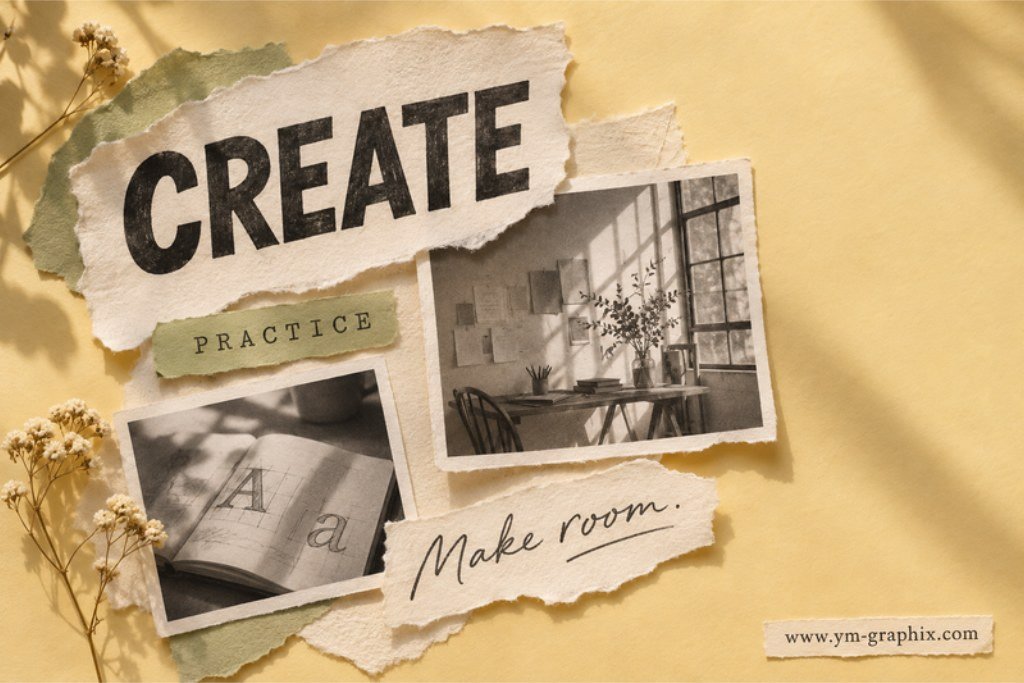
These are illustrative compositions, not product previews. Each uses a different relationship between the headline, supporting words and pictures. You can build all three with your own photographs and handwritten paper strips.
The sunny creative board
CREATE
Supporting words: Curiosity · Practice · Share
One short line: Give your ideas somewhere to land.
Picture ideas: A desk in daylight, an unfinished sketch and one small piece of work you are proud of.
Composition: Use a warm yellow strip for CREATE, cream paper for the supporting words and a handwritten note beneath the sketch.
A first step: Choose one idea to sketch for fifteen minutes this week.
The quiet new chapter
MAKE ROOM
Supporting words: Calm · Space · Begin
One short line: Your next chapter can begin quietly.
Picture ideas: A clear reading corner, a footpath and a notebook opened to a clean page.
Composition: Choose generous margins, charcoal lettering and a single sage accent. Let MAKE ROOM sit across the top without crowding the pictures.
A first step: Clear one surface or protect one short block of quiet time.
The brave next step
COURAGE
Supporting words: Voice · Learn · Connection
One short line: A little courage can fit into an ordinary day.
Picture ideas: A place you want to visit, a learning environment and a photograph that represents supportive company.
Composition: Build COURAGE from cutout letters. Keep the sentence below it in plain type so the two styles have different jobs.
A first step: Write down one question to ask, one invitation to make or one class to investigate.
If you prefer to keep the collage inside a notebook, our vision board journals and planners guide explores formats with room for reflection and practical notes. For the broader intention-setting approach, visit manifestation vision board ideas.
Turn a borrowed phrase into your own words
Some phrases look attractive but feel too general once they are on your wall. Before printing one, ask: What does this mean here, in my life? Replace abstract language with something you would recognize in a photograph or a diary entry.
- “Dream life” → “A weekday with time to create.” Look for pictures of the rhythm, place or activity you want.
- “Success” → “Finish the portfolio I keep postponing.” Give the word a project-sized meaning.
- “Abundance” → “Enough room for the things I value.” Decide what “enough” means to you before selecting images.
- “Be fearless” → “Try one thing while I am still learning.” Choose wording that leaves room for normal uncertainty.
You can use more than one language, too. A word from home, a phrase you share with someone, or a handwritten line in your first language may carry more meaning than a polished English slogan. Check spelling and accents before printing; some decorative letter sets may not contain every character you need.
Vision board words & quotes: common questions
What are good words to put on a vision board?
Good choices name something meaningful in your own life: courage, connection, calm, create, focus, home or begin. Choose one anchor word, then add a few supporting words that explain the direction you want to explore.
How many words should a vision board have?
There is no fixed number. As a starting layout, try one large anchor word, three supporting words and one short sentence. Add more only when each phrase gives your collage a distinct purpose and remains easy to read.
Can I make a vision board with words only?
Yes. Combine one large word, a few shorter phrases and handwritten notes. Use size, contrast and blank space to create a clear reading order. You can include dates or personal reminders if they help you use the board.
What is the difference between a vision board quote and an affirmation?
A quote or short line expresses an idea you want to remember. An affirmation is usually phrased as a personal statement, such as “I can begin with what I have.” Choose the form that feels natural; your board can include both.
Where can I find printable vision board words?
You can type your own words, print them on plain paper and cut them into strips. Digital word-label sets, affirmation decks and cutout alphabet graphics offer other design options. Check the included wording, formats and print size before choosing a download.
Can I change my vision board words later?
Yes. Replace a word when its meaning changes, a goal is completed or another priority becomes more relevant. Removable tape, clips and a journal pocket make it easier to update the wording without rebuilding the whole board.
Choose the word you want to live with
You do not have to find the perfect phrase for an entire year. Choose one word that feels useful now, give it a picture or a personal meaning, and leave room for it to change. “Create” can begin with a scrap of paper. “Connection” can begin with a conversation. “Courage” can begin with one question.
Write your word. Place it where you will see it. Then decide what a small version of it could look like today.