The quiet afternoon project · A beginner’s guide
A little paper. A few honest dreams.
A place to begin.
To make a vision board, choose a few goals, collect meaningful pictures and words, arrange them on a physical or digital surface, and connect each goal with a small next step. Keep it somewhere you will see it and revisit it as your priorities change.
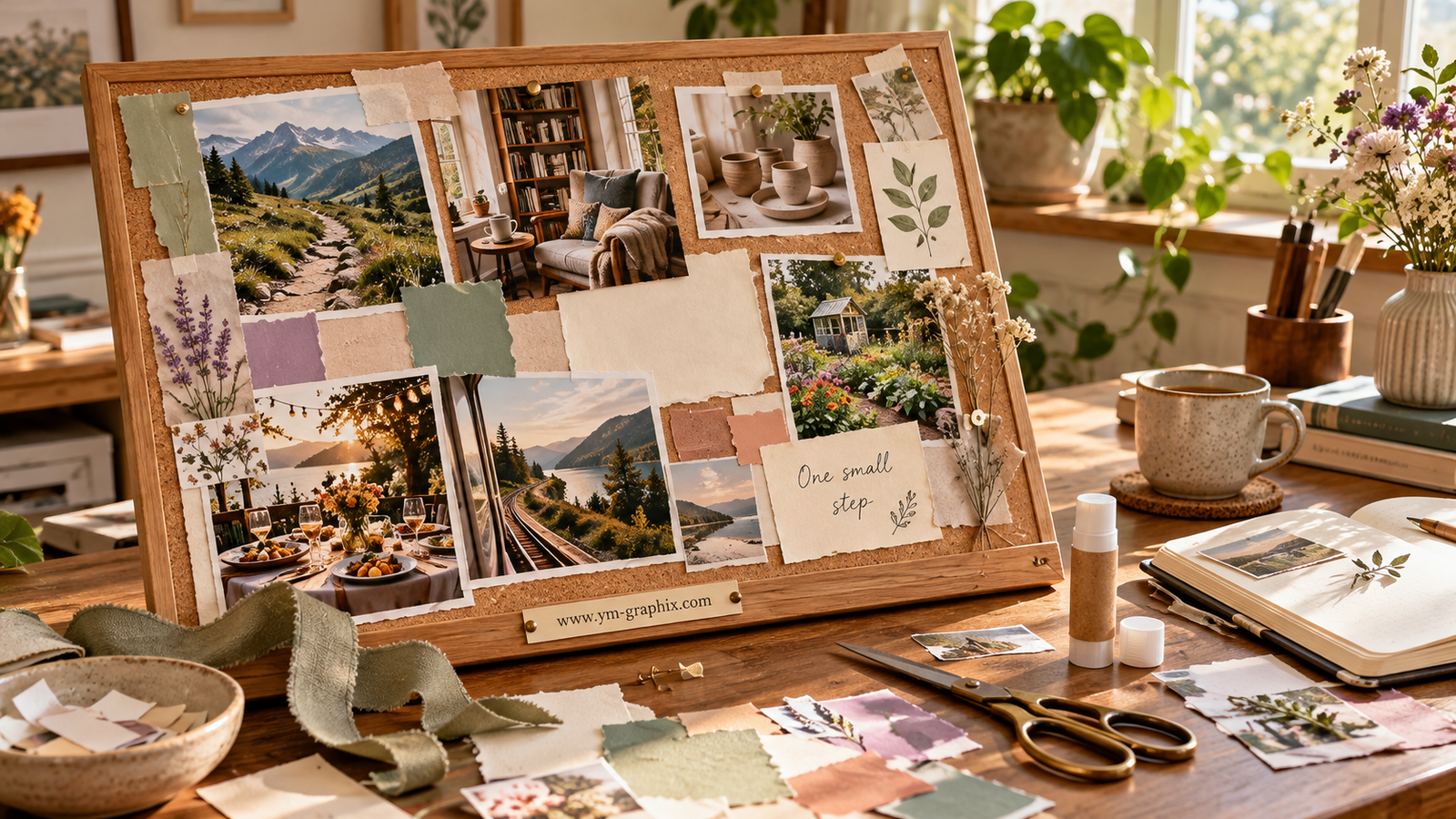
Think of it as a picture of the life you want to spend more time living. You can start with a scrap of cardboard, a notebook or a simple digital canvas. Make some space on the table, put the kettle on and let the first version be wonderfully unfinished.
What is a vision board?
A vision board is a collection of images, words and symbols representing things you want to work toward or make more room for. It can cover several parts of your life or one small project, such as learning a craft or creating a more restful home.
Your first board does not need to look like a magazine spread. The most useful starting question is: “What do I want this picture to remind me to do?”
For a paper board
- Cardboard, a pinboard or a notebook page
- Your own photos, cutouts or drawings
- Scissors and glue, tape or pins
- A pen and a few small notes
For a digital board
- A blank page in a collage or slide editor
- Images you have permission to use
- A few short text labels
- A saved editable copy for later changes
How to make a vision board, step by step
Choose a few goals that belong to you
Before opening a magazine, take a blank page and finish these sentences: “I want more…”, “I want less…” and “I would love to try…”. Think about an ordinary Tuesday as well as the big milestones. What would make your actual life feel better?
Choose three to five priorities as a starting point. You might want a calmer home, a new skill, more time outside or a more satisfying working routine. You do not need a goal for every category, and you do not need to display anything you would rather keep private.
Pick a format you will actually see
A physical board is lovely if you enjoy cutting, layering and moving paper around. Use cardboard, a pinboard or a page in a notebook. A digital collage suits a phone, tablet or computer. Neither format needs to be elaborate.
Choose the location before the size. A small board beside your desk may be more useful than a huge poster that ends up behind a door. If your goals are personal, a journal spread or a private digital file can be a comfortable choice.
For a notebook-sized version, our vision board journal guide explores ways to keep your pictures and reflections together.
Collect pictures with a reason behind them
Look for images that mean something to you: your own photographs, magazine cutouts, postcards, sketches or pictures you have permission to print. Start with a small pile. You can always add more later.
Choose both the destination and the experience. A picture of a mountain might represent a particular trip; a pair of walking shoes might represent the short walks that help you prepare. A beautiful kitchen might mean cooking at home, rather than buying that exact kitchen.
- Ask: What does this image represent in my life?
- Keep: Pictures that connect with a chosen priority.
- Set aside: Images you love visually but do not personally want to pursue.
If you want ready-to-print material, our vision board printables guide is an optional place to browse. You can complete this project using materials you already own.
Add words that sound like your own voice
Give each priority a short phrase. “Make room to read,” “Learn something new” or “A slower Sunday” can say more than a long paragraph. Handwriting adds personality, even when it looks a little uneven.
Use words to clarify a picture, rather than filling every gap. If an affirmation feels uncomfortable or unbelievable, rewrite it as a direction you can work toward: “I am practicing speaking up” or “I can take one useful step today.”
Arrange everything before you attach it
Lay your pieces on the board without gluing. Begin with one larger image or phrase that sets the mood, then place smaller pictures around it. Try grouping by goal, or create a loose collage if that feels more natural.
Leave breathing room between important elements. Crop pictures that compete for attention, shorten hard-to-read text and remove anything that makes the board feel crowded. A limited palette can pull different photos together, but clarity matters more than matching colors.
Take a quick photo of your favorite arrangement before moving the pieces. Then pin, tape or glue them down. For a digital board, save an editable copy before exporting the finished image.
Give each dream one small next step
This is where the collage becomes something you can use. Add a small removable note beside each priority, or keep an action list in your notebook. Write a step that is specific enough to start.
- More time outdoors: Choose a nearby walking route for Saturday.
- A creative hobby: Check the date of one beginner workshop.
- A calmer home: Clear one shelf before adding new decorations.
- A career change: Update one section of your résumé.
You do not have to put every task on the board. Let the board hold the direction, and let your calendar or planner hold the practical details.
Place it, revisit it and let it change
Put the finished board somewhere that fits your routine: above a desk, inside a cupboard door, on a journal page you open regularly or as a digital background. Keep the important details readable at that size.
Choose a check-in rhythm that feels manageable; once a week is a simple place to start. Ask: “What still matters?”, “What did I try?” and “What is my next small step?”. Move a note, replace a picture or retire a goal when it no longer fits.
A vision board is a personal planning aid. Looking at pictures does not guarantee an outcome; its practical value is in the reminders, reflection and actions you choose to connect with it.
A small board, made personal
Example: a calmer, more creative next chapter
Imagine you want a little more quiet, a creative hobby and more time outside. Instead of filling a board with someone else’s dream life, you build three small clusters:
A place to pause
Picture: A chair beside a window.
Words: “Room to breathe.”
First step: Clear the small table beside your chair.
Something to make
Picture: A handmade ceramic bowl.
Words: “Be a beginner.”
First step: Find one local or online introductory class.
A little fresh air
Picture: A path through nearby trees.
Words: “Outside more often.”
First step: Pick a short route and put a walk in your calendar.
The finished collage tells a story you recognize. Each picture has a reason to be there, and each goal has somewhere to begin.
How to make a digital vision board
The same process works on a screen. Choose the goals first, then open a blank canvas in an editor you already know. If the collage will become a background, check the dimensions of your device and choose a matching canvas.
- Add one larger image, then group supporting pictures around your priorities.
- Use a few readable labels and leave space where app icons or a lock-screen clock will sit.
- Keep personal information out of any version you intend to share.
- Save the editable file, export an image and check it on the actual device.
If starting with a blank page feels awkward, our Canva vision board templates guide explores layout options. You can also build your own simple arrangement from scratch.
When your board does not feel quite right
It feels crowded
Remove images with the same meaning. Give each main priority a little more space.
It looks lovely but feels distant
Replace a picture chosen for its aesthetic with one connected to something you actually want.
It feels like pressure
Reduce the number of goals and include experiences, rest or learning alongside milestones.
You keep forgetting it
Move it into an existing routine and choose one small action at your next check-in.
A few questions before you begin
What should a beginner put on a vision board?
Start with three to five personal priorities, a few pictures that represent them, short phrases and one small next step for each priority. You can add details once the first version feels clear.
Can I make a vision board without buying anything?
Yes. Reuse cardboard, magazine pages, your own photos and a pen, or draw directly in a notebook. A digital collage can also use pictures you already have permission to use.
Can I make a vision board without pictures?
Yes. Use handwritten words, sketches, colors, symbols or a mind map. The goal is to create a visual reminder that makes sense to you.
Does a vision board have to cover a whole year?
No. You can make one for a project, a season, the next few months or a single area of life. Choose a time frame that helps you decide what belongs on it.
How often should I update my vision board?
There is no required schedule. Revisit it when your priorities shift, a goal is completed or the board stops feeling relevant. You can change one note without rebuilding the whole collage.
Do vision boards guarantee that goals will happen?
No. A collage cannot guarantee results. Use it alongside practical planning, regular reflection and actions within your control.
Your first small step
Choose one picture. Write one sentence.
You can begin before you have the perfect board, the perfect supplies or a beautifully organized plan. Choose one thing you want more of, find a picture that captures it and write down something you can try this week.
Then leave a little room for the next chapter.
Making it with friends? Our vision board party guide has ideas for turning the process into a relaxed creative evening.